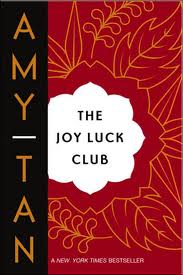
 | The Joy Luck Club -Amy Tan’s first book, The Joy Luck Club, was inspired by a trip to China that the author took with her mother. The title was borrowed from a weekly tradition established by her parents; they would invite their Chinese immigrant peers over for cards, Mahjong (a Chinese game similar to dominos), and specialty foods rooted in their heritage. The book was well received upon its release in 1989 and quickly became a bestseller. The book relates the stories of Chinese immigrant mothers and daughters; conflicts of identity, independence, cultural ambiguity, and control over one’s destiny are a few of the themes that emerge through the unfolding narratives. But in Tan’s own words the book is about hope and not just a limited work written for an immigrant audience. Originally the author had no grand scheme for the ultimate structure of the story although she received much praise for how The Joy Luck Club is organized. It’s broken into four sections with four short stories in each one to combine for a total of sixteen interconnected narratives, the common thread being the mother daughter relationship. Although the content is driven by this ongoing exchange the other themes that come to the surface are accessible to a much wider audience. |

Lost in Translation: Language as a Cultural Barrier
Throughout the course of the plot a disconnect between the American born daughters and the immigrant Chinese mothers is brought to the surface by the limits of language; while the mothers may attempt to tell their daughters the story of their lives it will always be limited by the difference of language. As a biographical side-note, Tan’s parents mistakenly believed that she should not learn to speak Mandarin because they thought it would conflict with her ability to use English. The subtlety embedded in language itself changes the way that these family members can relate to each other and ultimately raises the question of the degree to which cultures can remain unchanged when transplanted into new environments.

Children, Parents & Independence
“Rules of the Game” is a short story written much earlier that was later used within The Joy Luck Club. The story examines the shortcomings of communication between mother and daughter. Waverly is a young girl with a talent for chess who becomes frustrated by what she sees as her mother’s smothering attention to her new found hobby. Instead of seeing that her mother is proud of her daughter’s skill, Waverly seeks a separation between herself as her mothers daughter and an independent person who has abilities that are uniquely personal. Through this brief narrative the distinction between old and new is made a bit sharper; the value of independence as an American characteristic is embodied within the younger Chinese American child.

The Shape of Fate
The section titled “Half and Half” explores the idea of fate as well as the concepts of guilt and responsibility as they are associated with the outcomes of events. The character Rose marries an American doctor, Ted, but their marriage is tested by a lawsuit which her husband loses. Ted begins to question his own decisions and pressures Rose to take more responsibility for their shared decisions. He asks for a divorce and Rose is left in existential limbo; during this vulnerable stretch of time Rose takes a trip to the beach with her family and, in a lapse of attention, loses sight of her youngest brother whom she had been asked to watch. The boy drowns and Rose arrives at the conclusion that “fate is shaped half by expectation, half by inattention”.
The Joy Luck Club goes Hollywood.
An extended look at the film.
